

Crypto Exchange Scams 2026: How to Spot, Avoid, and Report Them
The rise of crypto exchange scams 2026 has reached an unprecedented level, with global losses now eclipsing the GDP of small nations and ensnaring everyone from first-time retail buyers to seasoned institutional traders. According to the Chainalysis 2025 Crypto Crime Report, victims lost a staggering $9.9 billion to crypto scams in 2024 alone — a 14% year-over-year increase. Meanwhile, the FBI’s Internet Crime Complaint Center (IC3) recorded a 45% jump in cryptocurrency fraud complaints, with investment fraud accounting for the largest single category of losses.
However, the story is not entirely bleak. Detection tools have matured. For example, real-time security firms like Blockaid blocked over 3 million malicious transactions in 2024 through their dApp scanner technology. Additionally, regulated exchanges have hardened their defenses with cold storage, proof-of-reserves audits, and biometric authentication. Therefore, the question is no longer whether scams exist — they obviously do — but whether you can recognize them before scammers drain your wallet.
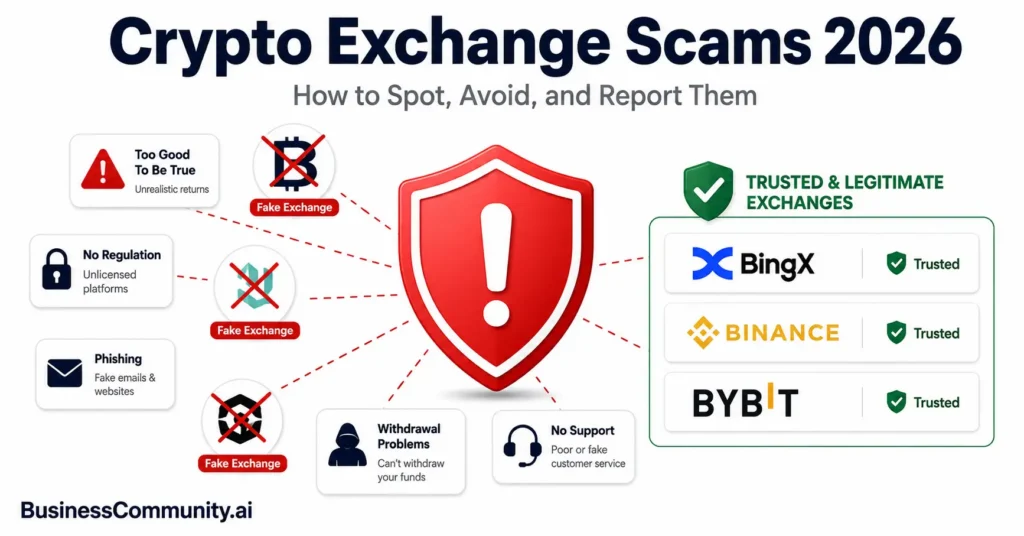
This guide breaks down the eight most common scam categories observed across 2025 and into 2026, the red flags every trader must memorize, the protections that reputable platforms offer, and the exact steps to take if you have already lost funds. Consequently, by the end of this article, you’ll carry the same situational awareness that professional forensics analysts use daily.
🔑 Key Takeaways
- $9.9 billion was lost to crypto scams in 2024 (Chainalysis), and 2026 projections suggest losses may exceed $12 billion.
- The most dangerous categories are pig-butchering romance scams, fake exchange clones, and rug pulls — collectively responsible for over 60% of losses.
- Regulated platforms with proof of reserves, cold storage, and mandatory 2FA remain the safest entry points for retail traders.
- If scammed, report to FBI IC3, local police, and blockchain forensics firms within 72 hours for the best recovery odds.
- Tools like Blockaid’s real-time scanner and on-chain explorers can prevent most drain attacks before signing.
The Scale of Crypto Exchange Scams in 2026
To understand the modern threat environment, you must first understand the numbers. Chainalysis reports that 2024 closed with $9.9 billion in confirmed scam losses across the global crypto ecosystem. However, that figure is conservative — it only counts on-chain activity tied to wallets the firm has positively identified as scam-controlled. In fact, the true number, factoring in unreported and off-chain losses, likely sits closer to $14–18 billion.
Notably, the FBI’s IC3 division logged its highest-ever volume of crypto-related complaints in 2024, a 45% increase from 2023. Investment fraud — including fake yield platforms and counterfeit exchanges — accounted for the largest dollar losses. Moreover, romance-based “pig butchering” schemes alone drained an estimated $4 billion from victims globally.
Furthermore, the threat is evolving. AI-generated voice cloning, deepfake video calls, and machine-learning-powered phishing kits have lowered the technical barrier for fraudsters. As a result, even sophisticated traders fall victim to attacks that would have been laughable in 2022.
Why 2026 Is Different
Three factors make this year uniquely dangerous:
- AI-powered social engineering: Scammers now run multi-month relationship campaigns using AI-generated personas indistinguishable from real humans.
- Cross-chain bridges: Stolen funds move across 5+ blockchains in minutes, making recovery exponentially harder.
- Regulatory fragmentation: Despite progress in the EU (MiCA) and Singapore, enforcement remains patchy globally, giving scammers safe harbors.
The 8 Most Common Crypto Exchange Scams 2026 Traders Must Know
Below is a categorized breakdown of the dominant scam typologies that Chainalysis, the FBI, and independent forensics teams have observed. Each one includes a risk label and the typical loss profile.
1. Rug Pulls HIGH RISK
A rug pull occurs when a project’s developers abruptly abandon a token, draining its liquidity pool and leaving holders with worthless assets. The scheme typically unfolds over weeks: first, developers launch a hyped token, recruit influencers, lock liquidity for a short period, then withdraw everything once volume peaks.
Chainalysis estimates rug pulls drained roughly $1.2 billion in 2024. Meanwhile, meme coin season has made the problem worse — thousands of tokens launch daily on Solana and Base, and over 95% of them are either intentional scams or vanity tokens with no economic substance.
How to spot one:
- Anonymous development team with no verifiable LinkedIn or GitHub history.
- Liquidity not locked, or locked for less than 12 months.
- Concentrated token ownership (top 10 wallets hold >40% supply).
- Aggressive shilling on Telegram and X with fake engagement metrics.
2. Fake Exchange Clones HIGH RISK
This category has exploded in 2025–2026. Specifically, scammers create pixel-perfect clones of legitimate exchanges, often using typo-squatted domains like “binance-pro.io” or “bingx-rewards.com.” Victims deposit funds, sometimes see fabricated balance growth, yet cannot withdraw without paying “release fees” — which themselves are pure theft.
Additionally, the FBI noted in its 2024 IC3 report that fake exchange platforms now account for nearly 30% of reported investment scam losses. Scammers often pair these schemes with romance lures, where the “trusted partner” walks the victim through funding the fake site.
3. Phishing Attacks HIGH RISK
Phishing in 2026 has evolved far beyond crude email scams. Modern campaigns include SMS spoofing (smishing), voice cloning of customer-support agents, and even fake “security alerts” delivered through legitimate-looking push notifications. Still, the goal is consistent: extract your seed phrase, private key, or 2FA code.
Furthermore, dark-web marketplaces sell wallet-drainer kits like the now-infamous “Inferno Drainer” and its successors as services. Consequently, they allow non-technical scammers to deploy convincing approval-stealing pages within minutes.
4. Romance and Pig-Butchering Scams HIGH RISK
“Pig butchering” — the slow grooming of a victim through fake romance before a financial slaughter — is the single most devastating scam category by dollar volume. The FBI estimates pig-butchering operations stole over $4 billion in 2024. In fact, victims often lose their entire life savings.
The pattern: first, a stranger contacts you on Tinder, WhatsApp, or LinkedIn, builds rapport over weeks, then introduces a “lucrative trading opportunity” on what turns out to be a fake exchange. Once you’re hooked, the platform blocks withdrawals behind escalating “tax” and “verification” fees.
5. Pump-and-Dump Schemes MEDIUM RISK
Coordinated groups on Telegram and Discord buy a low-cap token, hype it across social channels, then dump on followers who buy in late. Although smaller in average loss size, these schemes are extraordinarily common and prey heavily on inexperienced traders who feel FOMO when they see triple-digit pumps.
6. Flash Loan Attacks MEDIUM RISK
Although technically protocol exploits rather than direct user scams, flash loan attacks have drained over $700 million from DeFi platforms since 2023. Specifically, attackers borrow large sums in a single block, manipulate price oracles, and exit with the difference. As a result, users with funds in the affected protocols suffer collateral damage.
7. Ponzi and High-Yield Investment Programs (HYIPs) HIGH RISK
Promises of guaranteed daily returns of 1–5% are mathematically impossible to sustain, yet HYIP-style Ponzi schemes consistently attract billions. These platforms pay early investors with deposits from later ones until collapse. For example, JuicyFields, OneCoin, and HyperVerse remain cautionary cases — each cost victims hundreds of millions.
8. Impersonation and Support Scams MEDIUM RISK
Scammers impersonate exchange support staff, prominent influencers, or even friends whose Telegram accounts attackers have hijacked. They typically request “verification” of your seed phrase or ask you to install remote-access software. Notably, no legitimate exchange will ever request your seed phrase. Period.
Red Flags Checklist: Spotting Crypto Exchange Scams Before You Deposit
Before sending a single dollar to any platform, run through this checklist. If two or more items raise concerns, walk away.
| Red Flag | What It Indicates | Risk Level |
|---|---|---|
| Guaranteed daily returns | Ponzi or HYIP scheme | HIGH |
| No proof-of-reserves audit | Insolvency risk (FTX-style) | HIGH |
| Anonymous founders | Exit scam potential | HIGH |
| Withdrawal “release fees” | Confirmed scam | HIGH |
| URL typos / look-alike domain | Fake exchange clone | HIGH |
| No 2FA option | Substandard security | MEDIUM |
| Pressure to deposit quickly | Social-engineering tactic | MEDIUM |
| Unverifiable trading volume | Wash trading / fake liquidity | MEDIUM |
How Regulated Exchanges Protect Users from Crypto Exchange Scams
Not all exchanges are equal. Regulated, audited platforms have built layered defenses that materially reduce — though cannot eliminate — user risk. Here is what a credible exchange looks like in 2026.
Cold Storage and Hot Wallet Segregation
Reputable exchanges keep 95%+ of customer assets in cold storage — offline hardware wallets disconnected from the internet. Only the small operational float needed for daily withdrawals remains in hot wallets. Therefore, even a successful breach of the exchange’s online systems cannot wipe out the customer base.
Proof of Reserves (PoR)
After the FTX collapse, proof-of-reserves audits became table stakes. Modern PoR uses cryptographic Merkle trees to prove that an exchange holds 1:1 backing for every user balance. For example, BingX, Kraken, and a handful of others publish monthly attestations. Consequently, any exchange refusing to publish PoR in 2026 should raise immediate suspicion.
Multi-Layer Authentication
Mandatory 2FA via authenticator apps (not SMS, which suffers from SIM-swap vulnerabilities), biometric login, withdrawal whitelists, and time-locked withdrawals collectively form the user-facing security perimeter. Furthermore, anti-phishing codes — short strings displayed in legitimate emails — let users instantly distinguish real communications from impostors.
Real-Time Monitoring and SAFU-Style Funds
Top-tier exchanges deploy machine-learning fraud detection on every transaction. Suspicious withdrawals trigger automated holds. Additionally, many maintain insurance funds — capital pools earmarked to reimburse users in catastrophic breach scenarios.
If you’d like a deep technical breakdown of how one major exchange handles security, see our companion analysis: Is BingX a Scam? Full Security Audit.
RECOMMENDED PLATFORM
Trade Smarter on BingX — Start Free Today
Audited proof of reserves, cold storage for 95%+ of assets, mandatory 2FA, and a dedicated user-protection fund. Trade with confidence on one of the world’s most transparent exchanges.
No minimum deposit · Regulated · 24/7 support
What to Do If You’ve Been Scammed: A Step-by-Step Recovery Playbook
Speed matters. The first 72 hours after a scam offer the highest recovery odds. Funds move quickly across exchanges and mixers, and once they hit a sanctioned tumbler or non-cooperative jurisdiction, recovery becomes nearly impossible.
Step 1: Document Everything Immediately
First, take screenshots of every chat log, transaction hash, wallet address, website URL, and email. Then export your browser history. Also save app logs and photograph any physical evidence. The more documentation you have, the more useful you’ll be to investigators.
Step 2: Report to the FBI IC3 (or Your National Equivalent)
For U.S.-based victims, file at ic3.gov within 72 hours. IC3 funnels reports to the FBI’s Virtual Asset Unit, which coordinates with international partners and exchange compliance teams. Even if you live outside the U.S., filing with IC3 can help — since many scam operations have U.S. nexus through stablecoin issuers or U.S.-incorporated platforms.
Internationally, file with:
- UK: Action Fraud (actionfraud.police.uk)
- EU: Europol’s EC3 and your national cybercrime unit
- Australia: ReportCyber (cyber.gov.au)
- Canada: Canadian Anti-Fraud Centre
- Singapore: Singapore Police Force’s Anti-Scam Centre
Step 3: Notify the Receiving Exchange
If stolen funds reached a known exchange address, contact that exchange’s compliance team immediately. Then provide the transaction hash and your law-enforcement report number. Major exchanges including BingX, Coinbase, Kraken, and Binance maintain rapid-response teams that can freeze deposits within hours when alerted in time.
Step 4: Engage Blockchain Forensics
For losses above $25,000, professional forensics firms become economically viable. Reputable names include Chainalysis, TRM Labs, CipherTrace (Mastercard), Elliptic, and Crystal Intelligence. Specifically, these firms trace funds across chains, identify cluster ownership, and produce court-admissible reports.
Meanwhile, smaller losses can still be partially traced for free using public block explorers like Etherscan, Solscan, and Arkham Intelligence’s open dashboard.
Recovery Tools and Defensive Tech for 2026
The defensive toolkit has improved dramatically. Here are the platforms every serious crypto user should know about.
Blockaid — Real-Time dApp Scanner
Blockaid blocked over 3 million malicious transactions in 2024. Its real-time scanner integrates with major wallets including MetaMask and Rabby, analyzing every transaction signature request before you confirm. If the contract you’re about to interact with matches a known drainer, Blockaid flashes a red warning. For free, defensive software like this is essential.
Revoke.cash and Etherscan Token Approvals
If you’ve ever connected your wallet to a dApp, you’ve likely granted token approvals that persist indefinitely. Therefore, Revoke.cash lets you audit and revoke every active approval across multiple chains. Make this a quarterly habit.
Hardware Wallets
Ledger, Trezor, and the newer GridPlus Lattice keep private keys offline. For balances above $5,000, a hardware wallet is non-negotiable. Indeed, the cost ($80–$300) is trivial compared to the protection it provides.
AI-Assisted Investigation
Investigators increasingly use AI tools in recovery scenarios. For a fascinating case study, read our coverage of Claude AI’s role in recovering $400,000 in lost Bitcoin. Although AI cannot reverse blockchain transactions, it can assist with pattern recognition, address clustering, and even password recovery in specific scenarios.
Comparing Exchange Security: What to Look For
| Security Feature | Why It Matters | Must Have? |
|---|---|---|
| Proof of Reserves | Proves solvency post-FTX | ✅ Yes |
| 95%+ Cold Storage | Limits breach blast radius | ✅ Yes |
| Mandatory 2FA | Stops 99% of account takeovers | ✅ Yes |
| Withdrawal Whitelist | Blocks attacker exfiltration | ✅ Yes |
| Insurance Fund | Covers catastrophic events | ✅ Yes |
| SOC 2 / ISO 27001 | Verifies operational rigor | ⚠️ Preferred |
| Anti-Phishing Code | Authenticates legitimate emails | ⚠️ Preferred |
| Bug Bounty Program | Crowdsources security testing | ⚠️ Preferred |
Avoiding Crypto Exchange Scams 2026: The Behavioral Playbook
Technology alone won’t save you. Behavioral discipline matters equally. Here are the rules that professional traders and institutional custodians follow.
Rule 1: Never Share Your Seed Phrase
Your 12 or 24-word recovery phrase is the master key to your funds. No exchange, no support agent, no “wallet validator,” and no airdrop platform will ever legitimately ask for it. If anyone requests it, you face a scam. Full stop.
Rule 2: Bookmark, Don’t Search
Scammers buy Google ads that rank above legitimate exchanges. Therefore, always bookmark your exchange URL after verifying it on the company’s official social channels. Never click ads, even ones that appear official.
Rule 3: Verify Smart Contract Interactions
Before signing any transaction in MetaMask, read what you’re approving. “Approve unlimited” requests for tokens should trigger immediate caution. Additionally, use Blockaid or Rabby’s built-in transaction simulator to preview the actual on-chain effect.
Rule 4: Test Withdrawals First
When using a new exchange, first deposit a small amount and successfully withdraw it before sending larger sums. Scam exchanges often allow deposits freely and only reveal their true nature when you try to leave.
Rule 5: Treat Unsolicited Contact as Hostile
Anyone who reaches out to you first — on Telegram, X, LinkedIn, dating apps, or via DM — and steers conversation toward crypto is almost certainly a scammer. Block, report, and move on.
Rule 6: Diversify Across Custodians
Don’t keep everything on one exchange. Instead, split balances across two or three regulated platforms and a self-custody hardware wallet. Concentration risk killed countless FTX users; consequently, spreading exposure is now standard practice.
Regional Considerations for 2026
Scam dynamics shift dramatically by region. Southeast Asia, in particular, has become both a hotspot for victims and the operational base for many pig-butchering syndicates. If you’re trading from this region, our regional guides offer more specialized advice:
- How to Start Crypto Trading in Malaysia — Beginner’s Guide 2026
- BingX Review Philippines 2026: Is It Safe, Legit & Worth It?
- BingX vs Binance Malaysia — Which Is Better in 2026?
European users benefit from MiCA enforcement, which mandates exchange registration and capital requirements. Similarly, North American users have strong recourse through IC3 and FinCEN. Conversely, users in jurisdictions with weak crypto oversight should be especially cautious about which exchange they choose.
Conclusion: Vigilance Is the Price of Self-Custody
Crypto’s promise — financial sovereignty, borderless value transfer, programmable money — comes with an inescapable cost: personal responsibility for security. Banks reverse fraudulent charges. Blockchains, by design, do not. Therefore, the burden of avoiding scams falls squarely on each user.
However, the situation is improving. For example, detection tools like Blockaid prevent millions of attacks annually. Moreover, regulated exchanges publish proof of reserves and invest heavily in user protection. Law enforcement collaboration with blockchain forensics firms has produced major recoveries — most famously the Bitfinex hack recovery in 2022 and the ongoing dismantling of pig-butchering compounds across Southeast Asia.
The single most important decision you’ll make as a crypto user is where you trade. First, choose a platform with audited reserves, layered security, and a track record of customer protection. Then pair that platform with disciplined personal habits — hardware wallets, bookmarked URLs, skeptical defaults — and you’ll outperform 95% of crypto users on the only metric that ultimately matters: keeping what you earned.
Start Your Journey on BingX Today
Join millions of traders on a regulated exchange with proof of reserves, mandatory 2FA, and 24/7 fraud monitoring. Skip the scams — trade on a platform built for safety.