

Learning how to copy trade effectively is one of the most important skills for any crypto investor in 2026. Copy trading lets you automatically mirror the trades of experienced traders — therefore, you can earn passive income without reading charts, studying technical analysis, or monitoring markets daily. However, most people do it wrong. This guide shows you exactly how to copy trade effectively based on real experience, real trader data, and real settings we used on a live account.
If you want to know how to copy trade effectively, the first step is understanding which metrics actually matter when choosing a trader. Most copy trading guides come from people who have never actually copy traded. However, this guide is different. We have been copy trading on BingX since early 2026 — real money, real positions, real results. Additionally, everything here comes from actual experience: the trader we chose, the settings we used, what worked, and what the data looks like after weeks of following a real trader.
Quick summary: We followed a trader on BingX with an 80% win ratio, 3.37 Sharpe ratio, 28.92% 30-day ROI, 131 days active, 2,325 current copiers, and $1.9M in total copiers earnings. Here is exactly how we found them, why we chose them, and how we set everything up.
What is Copy Trading and How to Copy Trade Effectively?
Specifically, copy trading lets you automatically mirror the trades of an experienced trader in real time. When they open a position, your account opens the same position. Similarly, when they close it, yours closes too. Therefore, you do not need to analyse charts, study technical indicators, or follow crypto news. The trader does all of that — you simply allocate capital and let the system work.
In fact, copy trading is not just for beginners. In fact, learning how to copy trade effectively matters whether you are just starting out or have been in crypto for years. Ultimately, the difference between a profitable copy trader and one who loses money comes down to three things: first, choosing the right trader, then setting up your risk management correctly, and finally knowing when to stop.
Fortunately, the good news is that learning how to copy trade effectively does not require years of trading experience — it simply requires the right framework and the right platform.
New users may be eligible for a welcome bonus at sign-up. However, crypto trading involves risk — therefore, only invest what you can afford to lose.
Why Most People Fail at Copy Trading
Chasing the highest recent returns
The trader with 300% returns last month is almost always running extreme leverage or taking outsized risks. Those returns are not repeatable and the drawdown that follows is often catastrophic.
Copying too many traders at once
Spreading a small portfolio across 10 traders dilutes everything. You end up with overlapping positions, no clear risk management, and tiny gains that do not justify the complexity.
Not setting a stop loss
Copy trading without a stop loss is like driving without a seatbelt. A trader can hit a bad streak and wipe out a significant portion of your allocation before you notice.
Stopping too early
A good trader will have losing weeks. That does not mean their strategy is broken. Many people stop copying at exactly the wrong time, locking in a loss right before a recovery.
Ignoring max drawdown
If a trader has a 60% max drawdown, their followers lost 60% of their allocation at the worst point. That is critical information most beginners skip entirely.
How to Find the Best Copy Trader — Step by Step
When we opened the BingX Copy Trading Plaza, we first sorted traders by Copiers Earnings — not ROI. This shows which traders have actually made money for their followers, not just for themselves. Additionally, BingX lets you sort by ROI, Win ratio, Max drawdown, Sharpe ratio, Copiers Earnings and more. As a result, sorting by Copiers Earnings cuts through the noise immediately.
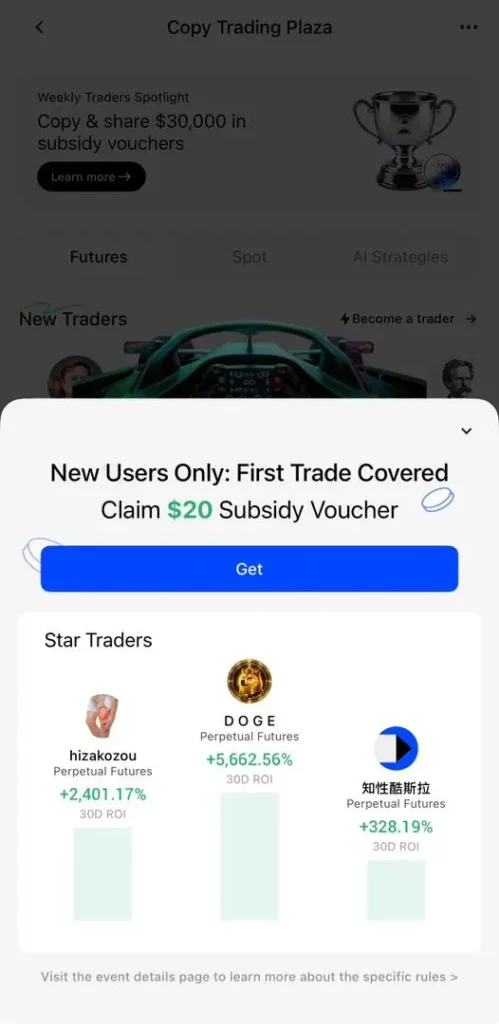
We also noticed BingX was running a promotion — new users get a $20 subsidy voucher for their first copy trade, which covers part of the first trade. Consequently, that provides a meaningful risk reduction for anyone just starting out.
Avoiding these mistakes is the foundation of how to copy trade effectively. However, most people skip at least one — and as a result, it costs them.
How to Analyse Copy Trader Data Before You Invest
Understanding how to copy trade effectively starts with reading trader data correctly. The metrics that actually matter are win ratio, Sharpe ratio, max drawdown, and copiers earnings. Therefore, once you know how to read these numbers, finding the right trader becomes straightforward.
Our Selected Trader
Perpetual Futures · 131 Days Active · 2,325 Current Copiers
Analysing the Key Metrics: What Each Number Tells You
The PnL ratio of 2,437 means winning trades were on average 2,437 times larger than losing ones. This means it is not luck — it is a deliberate asymmetric risk strategy where the trader cuts losses immediately and lets winners run. Consequently, this is exactly the kind of trader profile to look for when learning how to copy trade effectively.
This asymmetric risk profile is one of the clearest signals of a trader worth copying. Therefore, it represents the difference between copy trading effectively and just copying blindly. Furthermore, the Sharpe ratio of 3.37 sealed our decision. For example, anything above 1.0 is acceptable, above 2.0 is good, and above 3.0 is exceptional. Combined with an 80% win rate and $1.9M in copiers earnings, this trader met every criteria we look for.
Full Performance Metrics: What the Data Reveals
📈 Trader Profitability (30 Days)
| Metric | Value | What It Means |
|---|---|---|
| 30D ROI | +28.92% | Nearly 29% return in one month — strong but not reckless |
| 30D Profit | 1,884.19 USDT | Real dollar profit on their own account |
| 30D Win Ratio | 80% | 8 out of every 10 trades were profitable |
| Total Positions | 23 | Roughly 5–6 trades per week — not a high-frequency scalper |
| Win Positions | 21 | 21 winning trades out of 23 total |
| Loss Positions | 2 | Only 2 losing trades in 30 days |
| Average Profit | 273.46 USDT | Average winning trade size |
| Average Loss | 1.17 USDT | Average losing trade is tiny — excellent loss management |
| PnL Ratio | 2,437.78 | Winning trades are dramatically larger than losing ones |
🛡️ Trader Risk (30 Days)
| Metric | Value | What It Means |
|---|---|---|
| 30D Max Drawdown | 32.05% | Worst losing period — manageable with correct stop loss |
| 30D Risk Rating | 4 / 10 | Moderate risk — not reckless, not overly conservative |
| 30D Sharpe Ratio | 3.37 | Excellent — anything above 2.0 is considered very good |
⏱️ Trader Activities
| Metric | Value | What It Means |
|---|---|---|
| Copy Trading Days | 131 Days | Over 4 months of verified track record |
| Average Hold Time | 3D 6H | Holds positions for 3+ days — your copy trades have time to execute |
| Trading Frequency | 1.3 / week | Low frequency — reduces fees, reduces noise |
| Last Trading Time | 2026-04-30 | Recently active — not a dormant account |
👥 Copier Performance and Scale
| Metric | Value | What It Means |
|---|---|---|
| Copiers’ Earnings | +1,903,271.78 USDT | Followers have collectively earned $1.9M |
| Current Copiers | 2,325 | 2,325 people actively copying right now |
| Cumulative Copiers | 5,593 | Over 5,500 people have copied at some point |
| AUM | 1,893,530 USDT | Nearly $1.9M in assets under management |
| Profit Share | 16% | Trader takes 16% of your profits as their fee |
The Biggest Copy Trading Mistake — Don’t Fall For the Default Sort
Don’t Fall For the Default Sort — This Catches Almost Every Beginner
Almost every copy trading platform — BingX, Bitget, OKX, Bybit — shows traders sorted by ROI by default. You’ll see numbers like +2,401% and +5,662% immediately. That profit has already been made. If you enter now, you only get future returns — not past ones. The trader who made 2,401% six months ago may be doing 5% a month now.
Almost every copy trading platform shows traders sorted by ROI by default. As a result, you will immediately see traders with +2,401% and +5,662% ROI. However, that profit has already been made. If you enter now, you only get future returns — not past ones. Therefore, to copy trade effectively you must change the sort to Copiers Earnings or Win Ratio — never copy the top ROI trader by default.
How to Sort and Filter Copy Traders — What Each Metric Means
BingX’s Copy Trading Plaza lets you sort traders by multiple metrics. Here is how to use each one:
Sort by Copiers’ Earnings — This is the best starting point because it shows which traders have made real money for real followers. Therefore, this is our recommended first filter.
Sort by Win Ratio — Filter for traders above 65% win ratio because below 60% introduces too much variance for most passive investors.
Sort by Sharpe Ratio — Look for 2.0 and above. This filters out traders who generate returns through reckless leverage rather than genuine skill.
Sort by Max Drawdown — Match to your personal risk tolerance. For example, under 35% for conservative investors, under 40% for moderate.
Additionally, check average hold time — a trader who holds positions for 3 or more days gives your copy trades time to execute properly.
Finally, sort by ROI — Use this last, not first, because high ROI alone tells you nothing about how that return was achieved.
Copy Trading Settings — The Exact Setup We Used
The settings you choose are just as important as the trader you follow. Therefore, we set up our copy trading with a 20% stop loss, Fixed Amount mode, and Don’t Copy Existing Positions. These settings form the foundation of how to copy trade effectively without taking on unnecessary risk.
The 6 Settings Explained: Copy Mode, Stop Loss and More
Each trade copies a fixed dollar amount regardless of the trader’s position size — giving predictable, controlled exposure per trade.
Fixed Ratio mirrors the trader’s sizing proportionally and requires more capital. For most beginners, Fixed Amount is safer and easier to manage.
If our copy trading balance drops 20% from its starting value, the system automatically stops copying and protects our remaining capital.
Our trader’s 30D max drawdown is 32% — our 20% stop loss exits before their historical worst case while giving them room to operate normally.
We chose not to set a take profit threshold. The trader’s strategy has shown consistent monthly performance — we prefer to let it run and review monthly rather than arbitrarily capping our gains.
When you start copying, existing positions may have been opened days ago at very different price points. Copying them mid-trade means entering at current market price — significantly worse than the trader’s entry.
Starting fresh gives you the same entry timing as the trader — which is the whole point of copy trading.
BingX will not execute a copy trade if the price has moved more than 1% from the trader’s entry price by the time our order fills.
At 0% slippage many trades simply would not execute. At 1% we get clean fills in almost all normal market conditions.
We kept leverage set to same as the trader rather than customising it. Since the trader’s risk rating is 4/10 and Sharpe ratio is 3.37, their leverage usage is already conservative relative to returns.
Why These Settings Work Together for Capital Protection
These six settings work together to create a system that lets you copy trade effectively while also keeping your downside protected at all times.
We chose Fixed Amount over Fixed Ratio because it gives predictable, controlled exposure per trade. Additionally, we set a 20% stop loss — slightly below our trader’s 32% max drawdown — therefore giving them room to operate while protecting us if things go wrong. Furthermore, we chose Don’t Copy Existing Positions so we always enter at the same price as the trader.
What Copy Trading Actually Looks Like — Honest Observations
After several weeks of copy trading the trader we followed, here are our honest observations:
How to Increase Your Copy Trading Win Rate — 5 Strategies
Your win rate depends largely on the trader you choose — however, these steps improve your overall outcomes:
Choose a trader with asymmetric PnL
The trader we followed had an average profit of 273 USDT and an average loss of just 1.17 USDT. That asymmetry means even a 50% win rate would be profitable. Look for traders where average wins are significantly larger than average losses.
Never skip the stop loss
A copy trading stop loss is not optional. Markets move fast and a trader can hit a bad streak before you notice. Set your stop loss before activating and do not disable it.
Match the trader’s style to your patience level
A scalper who makes 50 trades a day is not suitable for a passive income investor. The trader we followed makes 1.3 trades per week — that suits someone who checks their account occasionally, not constantly.
Monitor monthly, not daily
Copy trading requires patience. Two losing positions in 30 days is normal — those two losses cost an average of 1.17 USDT each. Reacting to individual losses would mean missing the 21 winning trades that followed.
Start smaller than you plan to invest
Start with 50% of your intended allocation for the first month. Watch how the trader behaves across different market conditions. If everything holds up, scale to your full allocation in month two.
How to Copy Trade Effectively — Realistic Return Expectations
Based on the trader we followed’s 30-day data and our own experience, here is a realistic picture of what copy trading returns look like:
| Scenario | Monthly Return | Annual Return (compounded) |
|---|---|---|
| Conservative trader (low drawdown) | 5–8% | 80–150% |
| Moderate trader (like ours) | 15–25% net of profit share | 435–1,355% theoretical |
| Aggressive high-leverage trader | 30–50%+ | Unsustainable — avoid |
These are not guaranteed returns — crypto markets are volatile and all trading involves risk. Always use a stop loss and only invest what you can afford to lose.
How to Copy Trade Effectively on BingX — Key Features
Furthermore, BingX launched copy trading in 2019 and has refined it significantly since then. Here are the features that make a real difference:
- Transparent trader data — every metric visible before you copy
- Sort by Copiers’ Earnings — filters for traders who actually benefit their followers
- Fixed Amount and Fixed Ratio modes — flexibility for different risk approaches
- Don’t copy existing positions — clean entry on new trades only
- Slippage tolerance setting — protects against bad fills
- Demo copy trading — practise with virtual funds before committing real money
- $20 subsidy voucher for new users — first trade partially covered
- 40 million users, 17,000+ elite traders — deep pool to choose from
When to Take Profit on Copy Trading — Unrealised Gains Guide
One of the most common questions from copy traders is: “I am up 20% — should I close now or keep going?”
There is no universal answer, however, here is the framework we use:
| Unrealised Profit | What to Consider |
|---|---|
| +10% | Too early to close — let the trader’s strategy play out |
| +20–25% | Reasonable to take partial profit or set a trailing stop |
| +30%+ | Consider closing and restarting fresh next month |
| At stop loss % | System closes automatically — review before restarting |
⭐ Our approach
We do not set a Take Profit on copy trading. Instead we review monthly. If our unrealised profit is sitting at 25–30%, we evaluate whether to close and lock in gains or continue copying. The key is making that decision based on the trader’s metrics — not based on how the number makes you feel.
Unrealised profit is not yours until you close
A trader who is up 30% can give back gains quickly in a volatile market. If you have a meaningful unrealised gain and the trader’s metrics start showing warning signs — lower win rate, unusual trade frequency — that is the time to close and protect your profits.
Copy Trading Profit Share Explained — Is It Worth Paying?
When you copy a trader on BingX, the trader earns a profit share — specifically, a percentage of the profits your copy trading generates. However, this only applies to profits, not your capital. Therefore, if the trader loses money, you do not pay profit share.
In our example, the trader we followed charges 16% profit share.
Here is what that looks like in practice:
| Your Copy Trading Return | Profit Share (16%) | Your Net Profit |
|---|---|---|
| 10% on $500 = $50 | $8.00 | $42.00 |
| 20% on $500 = $100 | $16.00 | $84.00 |
| 28% on $500 = $140 | $22.40 | $117.60 |
✅ What you get for 16% profit share
- No charts to study or understand
- No technical analysis required
- No daily market monitoring
- No hours spent researching trades
- No sleep lost over open positions
- Trader takes the full emotional burden
⚖️ Copy trading vs fund manager
1–2% of capital yearly
Yes — always
Only on profits
No — pay nothing
The trader handles all of that — and also takes the emotional burden of making trading decisions. Therefore, 16% of your profit is a small price for all of that work being done for you.
In contrast, compare it to a traditional fund manager who charges 1-2% annually on your total capital regardless of whether they make you money. However, with copy trading profit share, you only pay when you profit. Consequently, if the trader has a losing month, you pay nothing.
Why Copy Trading Saves You More Than Just Money
The biggest advantage of copy trading is not the returns. It is the time.
Learning to trade crypto effectively takes months to years. For example, you need to understand:
- 📊
Technical AnalysisChart patterns, indicators, support and resistance
- ⚖️
Risk ManagementPosition sizing, leverage, stop losses
- 🧠
Market PsychologyHow to control fear and greed under pressure
- 🌍
Macro FactorsHow news, interest rates and sentiment affect crypto prices
| Factor | ✅ Copy Trading | ⚠️ Trading Yourself |
|---|---|---|
| Time required | Low — check monthly | High — daily monitoring needed |
| Knowledge needed | Basic platform understanding | Deep technical & market knowledge |
| Emotional stress | Low — decisions made for you | High — every trade is your decision |
| Profit potential | Good — follows trader’s strategy | Unlimited — but most retail traders lose |
| Cost | Profit share on gains only | No profit share — but higher risk of loss |
For most working adults who want crypto exposure without dedicating hours every day — copy trading is the most practical approach available in 2026.
The profit share you give the trader is not a cost. It is payment for a service that saves you hundreds of hours and removes the emotional burden of trading from your life entirely.
Therefore, for most working adults who want crypto exposure without dedicating hours every day — copy trading is the most practical approach available in 2026.
The profit share you give the trader is not a cost. Instead, it is payment for a service that saves you hundreds of hours and also removes the emotional burden of trading from your life entirely.
FAQ
How do I find the best trader to copy on BingX?
First, sort by Copiers’ Earnings — this shows which traders have actually made money for their followers. Then filter by Sharpe ratio (look for 2.0+), win ratio (60%+), and max drawdown (under 35%). Additionally, check their trading frequency and average hold time to make sure their style suits your patience level.
What is a good Sharpe ratio for copy trading?
A Sharpe ratio above 1.0 is acceptable, above 2.0 is good, and above 3.0 is exceptional. For example, the trader we followed’s Sharpe ratio of 3.37 means he generates strong returns relative to the risk he takes — which is one of the key reasons we chose him.
Should I copy existing positions when I start?
No — we recommend selecting “Don’t copy existing positions” when you start copying a new trader. This is because existing positions were opened at prices that may be very different from current market prices. Therefore, start fresh and copy only new trades to get the same entry timing as the trader.
What stop loss should I set for copy trading?
A 20% stop loss is a sensible starting point for most investors. This gives your trader enough room to operate through normal drawdown periods while also protecting you if something goes seriously wrong. Therefore, match your stop loss to slightly below the trader’s historical max drawdown.
How much money do I need to start copy trading on BingX?
You can start with as little as $20-50 USDT. However, a more practical amount is $100-500 USDT — enough to see meaningful returns while keeping risk manageable. Additionally, BingX new users also receive a $20 subsidy voucher that covers part of the first copy trade.
Is copy trading passive income?
Copy trading is as close to passive income as crypto gets — however, it is not completely passive. You still need to choose your trader carefully, set your stop loss, and review performance monthly. Therefore, think of it like hiring a fund manager — you are not doing the trading, but you are responsible for who you trust with your money.
You Might Also Like
- Best Crypto Exchange Malaysia 2026 — Rated & Reviewed
- BingX Review 2026 — Full Platform Analysis
- BingX Copy Trading Review — Step by Step Guide
New users may be eligible for a welcome bonus at sign-up. However, crypto trading involves risk — therefore, only invest what you can afford to lose.
RISK DISCLAIMER
Crypto trading involves significant risk. The value of digital assets can go up or down rapidly, and consequently, you may lose some or all of your invested capital. The trader data referenced in this article (the trader we followed) reflects past performance which does not guarantee future results. Additionally, this article is for informational purposes only and does not constitute financial advice. Therefore, always do your own research and consider seeking independent financial advice before investing. Only invest what you can afford to lose.