
Best AI Tools for Small Business: 90-Day ROI Framework
The best AI tools for small business ranked by 90-day ROI — not features. Stanford-MIT data, sequenced adoption framework, and real productivity benchmarks inside.

This guide to the best AI tools for small business contains affiliate links. If you purchase through our links, we may earn a commission at no extra cost to you.

In 2023, a team of economists from Stanford and MIT tracked more than 5,000 customer support agents working with and without an AI assistant. The headline finding was clean: agents using AI resolved 14% more tickets per hour. But the detail that matters for every small business owner reading this was buried in the distribution of those gains. The improvement was not evenly spread. The largest productivity jumps went to the lower-skilled, less experienced, generalist workers: the people doing five jobs at once because the company was too small to hire specialists.
That describes almost every small business team on earth.
If you run a business with three, eight, or twenty people, you are not staffed with narrow experts. You have generalists who answer support emails in the morning, chase invoices at lunch, and write marketing copy at night. The Stanford-MIT evidence says that profile is precisely the cohort that captures outsized returns from AI assistance, not despite being generalists, but because of it. AI compresses the skill gap. It lifts the floor faster than it lifts the ceiling. Selecting the best AI tools for small business is, therefore, less a technology decision than a sequencing one.
So this article does not do what almost every other “best AI tools for small business” article does. It is not a catalogue. It is not a longer feature list with affiliate buttons. It is a sequenced investment framework built on a single argument: choosing AI tools is a capital allocation decision, and like any capital allocation decision, the order in which you deploy capital matters more than the individual line items.
Why the Best AI Tools for Small Business Are a Capital Allocation Decision
Most small business owners approach AI tools the way they approach a buffet, sampling whatever looks appealing, signing up for free trials, and ending up three months later paying for nine subscriptions they barely use. The problem is not the tools. The problem is the absence of a framework for deciding which tool earns the next dollar of your limited budget and your even more limited attention.
Treat the decision the way a finance director treats capital. You have finite resources, money, but more importantly time and the cognitive bandwidth of a small team. Every tool you adopt has an acquisition cost (the subscription) and a far larger hidden cost (the learning curve, the integration effort, the behaviour change required). The return is measured in hours recovered or revenue generated. A capital allocation lens forces you to ask the only question that matters: what is the payback period, and what should I fund first?
The Stanford-MIT Finding Every Small Business Owner Should Know
The 2023 Stanford and MIT study, led by economists Erik Brynjolfsson, Danielle Li, and Lindsey Raymond, is the most rigorous evidence we have on what AI actually does to frontline productivity. Across the support agents studied, AI assistance lifted output by 14% per hour on average. Crucially, novice and low-skilled agents improved by around 35%, while the most experienced agents saw little to no measurable gain.
Read that asymmetry carefully, because it inverts the usual assumption. Many owners delay adopting AI because they think “my team isn’t technical enough.” The evidence says the opposite. The less specialised your team, the larger the gain available to you. AI did not replace the expert’s judgement, it transferred a usable approximation of that judgement to everyone else. For a small business, that is the entire value proposition in one sentence.
Why this matters for you
If your team is made up of capable generalists rather than narrow specialists, you are statistically the cohort most likely to see large returns from AI, provided you adopt in the right order. The framework below sequences that adoption.
Why Feature Lists Fail and ROI Frameworks Win
A feature list answers a question nobody serious is asking. “Which tool has the most integrations?” is irrelevant if you will never use eight of them. The flaw in the list format is that it presents every category as equally urgent and every tool as equally worth your time, when in reality the returns are wildly uneven.
Consider the difference. An AI writing assistant deployed by a solo founder who drafts twelve emails and two proposals a day produces an almost immediate return, measured in days. An AI analytics platform deployed by the same founder before they have clean data or the time to interpret dashboards produces nothing for months. Same owner, same budget, radically different payback. A list treats them identically. A framework does not.
The ROI framework wins because it imposes sequence. It says: deploy the tools with the shortest payback and the lowest learning curve first, bank the recovered hours, and reinvest that recovered time into adopting the next, harder tier. You compound your way up the difficulty curve rather than drowning in it on day one.
How to Read This Article: The 90-Day Sequenced Adoption Model
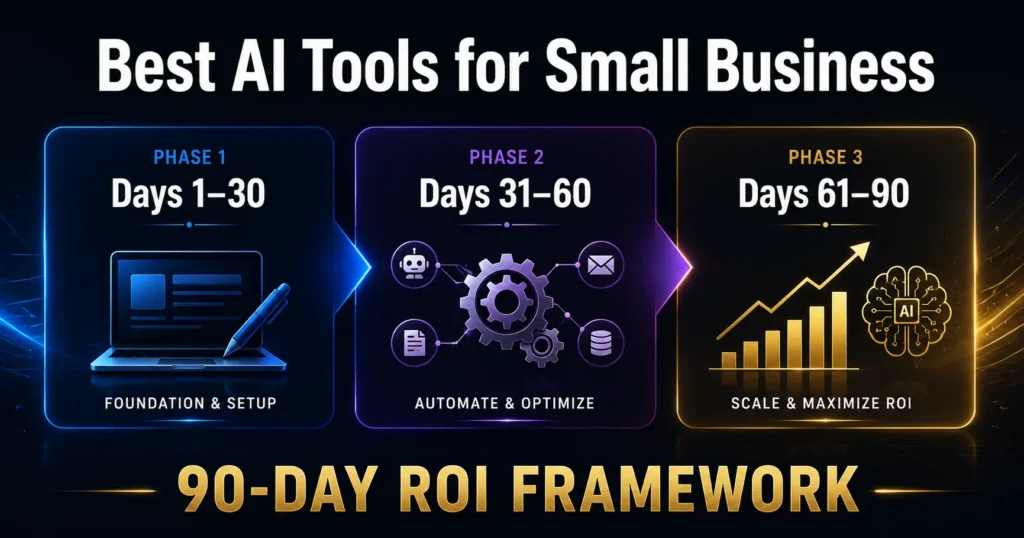
The structure of this article maps to a 90-day adoption plan divided into three tiers. Tier 1 (Days 1–30) covers immediate-return tools with near-zero learning curve. Tier 2 (Days 31–60) covers process automation that compounds over time but requires setup. Tier 3 (Days 61–90) covers strategic intelligence tools that pay off only once the foundation beneath them exists.
You do not need to adopt everything. Most small businesses will extract 80% of the available value from Tier 1 and a single Tier 2 workflow. The point of the sequence is not maximum tool count, it is maximum return per unit of attention spent. Read the tiers in order, and resist the urge to jump to Tier 3 because it sounds more sophisticated. Sophistication without a foundation is how AI budgets get wasted.
The 90-Day AI Adoption Sequence: Which Tools to Deploy First
The sequence below is the core of this article. It is deliberately conservative on tool count and deliberately strict on order. Each tier assumes you have completed the one before it, because the recovered time and the operational confidence from each stage is what funds the next.
| Phase | Tool category | Typical payback | Learning curve |
|---|---|---|---|
| Days 1–30 | Writing, support, scheduling assistants | Days to 2 weeks | Minimal |
| Days 31–60 | Marketing, bookkeeping, CRM automation | 3–8 weeks | Moderate (setup required) |
| Days 61–90 | Market research, analytics, hiring intelligence | 2–6 months | Steep (needs data + judgement) |
Days 1–30: High-ROI, Zero-Learning-Curve Tools
The first 30 days exist to do one thing: produce a visible, undeniable win that builds the team’s appetite for more. This is psychological as much as operational. If the first AI tool you deploy is complicated and pays off slowly, your team concludes “AI is hype” and resists everything that follows. So you front-load the easy wins.
These are tools that require no integration, no data migration, and no behaviour change beyond opening a different tab. A writing assistant. A support draft generator. A meeting scheduler. The kind of tool where a generalist on your team is producing useful output within an hour of first use, which is exactly the cohort the Stanford-MIT study says benefits most.
Days 31–60: Process Automation That Compounds Over Time
Tier 2 is where the returns shift from “saves me an hour today” to “saves the business an hour every day forever.” These tools require setup, connecting your email, your accounting software, your CRM, and that setup cost is real. But once configured, they run in the background and the recovered time compounds.
This is also where most owners fail, because they attempt Tier 2 on day one before banking the easy wins. The setup friction kills momentum. By deploying these in the second month, you arrive with both confidence and a baseline of recovered hours to reinvest into configuration.
Days 61–90: Intelligence Layer Tools for Growth and Decision-Making
By month three, the Tier 3 tools, analytics, market research, hiring intelligence, only pay off once you have clean data flowing and the operational headroom to act on what they surface. An analytics dashboard is worthless if nobody has time to read it. A competitor intelligence tool is noise if you are too busy firefighting to respond. By month three, the time recovered in Tiers 1 and 2 has created the bandwidth these tools require.
⚠ Common mistake
The single most expensive error small businesses make is adopting Tier 3 tools first because they sound impressive. Strategic intelligence with no operational foundation beneath it is the most reliable way to waste an AI budget.
Best AI Tools for Small Business: Tier 1: Immediate Productivity Return
Tier 1 tools share three traits: sub-$50/month pricing, no integration required, and useful output within the first hour. The Goldman Sachs 2023 AI Infrastructure Report noted that the per-unit cost of AI inference has fallen roughly 10x every 12 to 18 months since 2020, which is exactly why enterprise-grade capability now sits inside tools cheaper than a team lunch.
AI Writing and Communication Assistants
For most small businesses, written communication is the single largest time sink that AI can attack immediately. Proposals, client emails, follow-ups, product descriptions, social posts: the volume is enormous and the quality bar is “clear and professional,” not “literary.” That is the sweet spot for current AI.
The practical recommendation: start with a general-purpose assistant such as ChatGPT (the $20/month Plus tier) or Claude before buying any specialised writing SaaS. Most niche writing tools are thin wrappers around the same underlying models, charging a premium for a narrower interface. A generalist owner who learns to prompt a general model directly captures most of the value without the markup. Add a specialised tool only when you identify a specific, repeated workflow it genuinely accelerates.
💡 Tip
Before buying any specialised writing tool, spend two weeks using a general model and document the three writing tasks you repeat most. Only then evaluate whether a dedicated tool beats the generalist for those specific tasks. Usually it does not.
AI Customer Support and Response Tools
This is the category the Stanford-MIT study measured directly, so treat it as the highest-confidence ROI in the entire article. AI support assistants draft responses, suggest knowledge-base answers, and summarise ticket history, letting a generalist resolve tickets at something closer to a specialist’s pace.
For very small teams, you do not need a dedicated support platform. A shared inbox with AI draft suggestions (built into tools like Help Scout, Front, or even Gmail with an AI extension) captures most of the gain. Reserve full conversational AI support agents for when ticket volume genuinely justifies the configuration effort, which for most micro-businesses is later than they assume.
AI Scheduling and Administrative Automation
Scheduling, meeting notes, and basic admin are the quiet hours-killers. AI scheduling assistants that read your calendar and propose times, plus AI notetakers that transcribe and summarise calls, return time with essentially zero learning curve. These are unglamorous, which is precisely why they are underused and why they belong in week one. The owner who reclaims four hours a week from scheduling friction has just funded the rest of their adoption journey.
Best AI Tools for Small Business: Tier 2: Process Automation
Tier 2 is where AI stops being a personal productivity aid and starts becoming infrastructure. According to the 2024 Salesforce State of the SMB report, 65% of small business owners who adopted AI cited time savings on routine tasks as the primary benefit, and routine tasks are exactly what Tier 2 automates at the process level rather than the task level.
AI-Powered Marketing and Content Workflows
The Tier 2 marketing move is not “generate more content”, it is building a repeatable workflow. A typical setup: an AI tool drafts a month of social posts from a single brief, schedules them, and repurposes a long-form piece into five formats. Tools like Buffer’s AI assistant, Jasper, or a combination of a general model with a scheduler turn what was a weekly scramble into a monthly batch session.
The compounding return here is real but contingent. It only materialises if you commit to the workflow rather than reverting to ad-hoc posting. That is why this belongs in month two, you need the discipline that month one’s wins help build.
AI Bookkeeping and Financial Operations Tools
Financial admin is high-friction, high-error, and high-anxiety for small business owners, which makes it a prime automation target. AI features inside QuickBooks, Xero, and dedicated tools like Ramp now auto-categorise transactions, flag anomalies, chase invoices, and reconcile accounts. The setup requires connecting bank feeds and accounting software, which is why this is Tier 2 rather than Tier 1.
The return is partly time and partly risk reduction. An AI that flags a duplicate payment or a miscategorised expense before your accountant does saves money that never appears on a productivity dashboard but is real nonetheless.
AI Sales and CRM Assistance
AI inside a CRM, lead scoring, follow-up drafting, deal summarisation, next-step suggestions, converts a generalist who hates “sales admin” into someone who reliably follows up. HubSpot, Pipedrive, and Salesforce all now embed AI assistants. For a small team where the owner is also the salesperson, the value is in never letting a warm lead go cold because nobody had time to write the follow-up.

Best AI Tools for Small Business: Tier 3: Strategic Intelligence
Tier 3 is the tier most articles lead with and most small businesses should adopt last. These tools inform decisions rather than execute tasks, and a decision-support tool is only valuable to someone with the time and clean inputs to act on it.
AI Market Research and Competitor Analysis
AI research tools: Perplexity for synthesised research, AI-driven competitor monitoring, sentiment analysis of reviews, can compress days of manual research into minutes. For a small business considering a new product line or market, this is genuinely useful. But it is strategic, occasional work, not daily operations, which is why it sits in Tier 3. You reach for it when making a specific decision, not every morning.
AI Analytics and Business Decision Support
AI analytics layered over your sales, web, and financial data can surface patterns a busy owner would miss. The prerequisite, however, is clean data and a person with the bandwidth to interpret it. Deploy this once Tiers 1 and 2 have recovered enough time that someone can actually act on what the analytics reveal. An unread dashboard is a cost, not an asset.
AI Tools for Hiring and Team Operations
As a small business grows past its first handful of employees, AI tools for screening applications, drafting job descriptions, and summarising candidate interviews reduce the enormous time cost of hiring. This belongs in Tier 3 because it is episodic, you hire occasionally, and the value only appears when you are actively recruiting. Adopt it when you are about to hire, not before.
What the Evidence Actually Says About Small Business AI Outcomes
Stripped of vendor marketing, the independent evidence on small business AI outcomes is more encouraging, and more specific, than the hype suggests. Three findings deserve scrutiny.
Productivity Benchmarks: What Adopters Are Reporting
The Stanford-MIT 14% per-hour figure remains the most rigorous benchmark, because it measured actual output in a real workplace rather than self-reported satisfaction. The Salesforce 2024 SMB report adds the demand-side view: 65% cited time savings as the primary benefit, 42% cited cost reduction, and 31% cited improved customer experience. Note the order, owners value recovered time above cost cuts, which validates the time-first sequencing in this framework.
The Widening Gap Between Adopters and Non-Adopters
Analysis published by the U.S. Small Business Administration in late 2024 suggested that AI-adopting small businesses reported revenue growth rates roughly twice as high as comparable non-adopters over a 24-month window. The SBA is careful to note this is correlation, not causation, more capable, better-run businesses may simply be both more likely to adopt AI and more likely to grow. Read it as suggestive, not conclusive. But the direction is consistent across multiple datasets, and McKinsey’s 2024 State of AI report found SMB adoption roughly doubled from about 20% to 40% between 2022 and 2024. The window in which AI adoption is a differentiator rather than a baseline is closing.
Why Lower-Skilled Generalist Teams Gain the Most
Return to the asymmetry that opened this article, because it is the load-bearing insight. AI lifts the floor faster than the ceiling. The mechanism is straightforward: an expert already knows the best response, so an AI suggestion rarely improves on it. A novice does not, so the AI suggestion closes most of the gap to expert performance instantly. Small business teams are disproportionately novices-at-many-things rather than experts-at-one, which is exactly why the framework assumes large available gains, provided you adopt in order.
How to Evaluate Any AI Tool Before You Pay for It
Choosing the best AI tools for small business from a market of over 400 options is genuinely overwhelming, well over 400 by most counts, growing weekly. Statista projects the global AI software market will reach $126 billion by 2025, with SMBs the fastest-growing cohort by user count. You cannot evaluate them all. You need a filter that you can apply in five minutes.
The Four Questions to Ask Before Subscribing
1. What specific hour does it remove?
If you cannot name the recurring task it eliminates, do not buy it.
2. What is the payback period?
Hours saved per month × your hourly cost vs. the subscription. Under one month is excellent.
3. Can a generalist use it in an hour?
If it needs a specialist or a week of training, it belongs in a later tier, or not at all.
4. Does a tool you already pay for do this?
Your existing CRM, email, or accounting software likely added AI features you are not using.
Red Flags That Signal a Tool Will Not Deliver ROI
Some signals reliably predict wasted money. Be sceptical of any tool that markets capability breadth (“does everything!”) rather than a specific outcome, breadth usually means it does nothing especially well. Be wary of tools that require migrating your data away from systems you already use; switching cost rarely pays back. And treat any tool that cannot articulate the specific task it eliminates as a solution searching for a problem. Finally, free trials that demand a full data integration before you can test core value are engineered to create sunk-cost lock-in, not to demonstrate worth.
Budgeting AI Tools as a Percentage of Labour Cost Saved
Here is the discipline that keeps AI spending rational: budget each tool as a fraction of the labour cost it offsets, not as a flat “AI budget.” If a $30/month tool saves a generalist earning $25/hour roughly five hours a month, that is $125 of recovered labour against $30 of cost, a payback ratio above 4x. Fund anything clearing 3x quickly. Scrutinise anything below 2x. Cut anything you cannot measure at all within 60 days. This converts a vague “are we spending too much on AI?” anxiety into a clean per-tool calculation any owner can run.
AI Tools and the Broader Technology Transformation Facing Small Business
Stepping back, the sequenced adoption framework in this article is a small business’s local response to a much larger structural shift. The collapse in AI inference cost that Goldman Sachs documented is the same force pushing capability from enterprise budgets down to sole traders, part of AI’s role in the broader industrial transformation reshaping how value is created across every sector.
That transformation does not stop at productivity tools. The same underlying models now drive entirely new asset classes and business models, including how AI is reshaping the crypto token industry, a reminder that the AI you adopt to draft emails this month is built on infrastructure that is simultaneously rewriting markets you may not yet operate in.
The Window for Competitive Advantage Is Closing
For the small business owner, the practical takeaway is narrower and more urgent. The McKinsey data showing SMB adoption doubling to roughly 40% means the competitive advantage of being an early adopter is decaying into the baseline expectation of being a competent operator. Choosing the best AI tools for small business through this 90-day sequence is not about chasing novelty. It is about capturing a measurable productivity gain that the evidence says is largest for exactly your kind of team, while it still differentiates you, and before it merely keeps you level.
Frequently Asked Questions
What is the single best AI tool for a small business just getting started?
A general-purpose AI assistant: ChatGPT Plus or Claude at roughly $20/month, is the best first purchase for nearly every small business. It requires no integration, produces useful output within an hour, and covers the highest-volume time sink most owners face: written communication. Master a general model before buying any specialised tool; most niche writing apps are wrappers around the same models at a higher price.
How much should a small business budget for AI tools each month?
Budget per tool, not as a lump sum. Each tool should clear a payback ratio of at least 3x, hours saved multiplied by your hourly labour cost, divided by the subscription price. In practice, most small businesses extract the bulk of available value from $50–$200/month total across two or three well-chosen tools. Spending more than that early usually signals tool sprawl rather than genuine returns.
Which AI tools produce measurable ROI in the first 90 days?
Tier 1 tools deliver the fastest measurable return: writing assistants, AI support draft tools, and scheduling automation, all of which pay back within days to two weeks. Process automation tools in Tier 2 (marketing workflows, AI bookkeeping, CRM assistance) pay back over three to eight weeks. Strategic intelligence tools in Tier 3 typically take two to six months and should be adopted last, once recovered time creates the bandwidth to use them.
Do AI tools work better for certain types of small businesses than others?
The Stanford-MIT evidence suggests the biggest gains accrue to teams of capable generalists rather than narrow specialists, because AI lifts novice performance toward expert performance faster than it improves experts. Businesses with high volumes of written communication, customer support, and routine admin see the largest immediate returns. Specialist-heavy firms where staff already operate at expert level see smaller per-task gains.
What does the Stanford-MIT productivity study mean for small business owners?
The 2023 study found AI assistance lifted customer support output by 14% per hour, with the largest gains, around 35%, going to lower-skilled, less experienced workers. For owners, this inverts a common fear: a team that “isn’t very technical” is statistically more likely to benefit, not less. AI closes the gap between novice and expert performance, and small business teams are disproportionately generalists rather than specialists.
How do I avoid wasting money on AI tools that do not deliver results?
Apply four questions before subscribing: What specific recurring hour does it remove? What is the payback period? Can a generalist use it within an hour? Does a tool you already pay for already do this? Avoid tools that market breadth over a specific outcome, that require migrating data away from existing systems, or that cannot name the task they eliminate. Cut any tool you cannot measure within 60 days.